
Leading UX and Creative Direction at Filament Games
Zero-to-one design for 10+ shipped learning products
Company: Filament Games
Role: UX Design, Systems Design, Creative Direction, Cross-Team Leadership
The Challenge
Filament Games is a mission-driven, work-for-hire studio building learning products from the ground up, each one meant to teach something or support a real decision for whoever was on the other end. Word Raider needed to build students’ academic vocabulary through an adventure game, SimuLawyer needed to help law students prepare for the bar exam through simulated casework, and Cool Choices needed to turn workplace sustainability habits into something employees would actually want to engage with. Whatever form a project took, my job was to design for that person’s success.
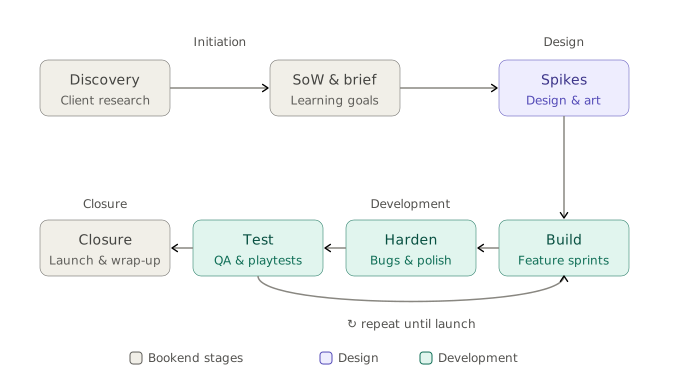
Each project started with design discovery that ended in an SoW (statement of work) and a creative brief for the team. That brief almost always centered on the project’s core Learning Objectives, and every design decision had to be made in service of them. A project’s success depended less on whether it was fun or usable in the abstract, and more on how effectively it helped the person on the other end of the screen learn or accomplish what the product was meant to teach them.
Many of our clients, publishers and institutions with deep subject-matter expertise but little or no game or product design experience, came to us with strong opinions about what they wanted built. Part of my job was helping them get to a better answer than the one they walked in with.
The Approach
After each kickoff, we moved into a run of design sprints. I worked with the Lead Game Designer to determine which mechanics would create the most rewarding experience for users while also serving the Learning Objectives, then relayed our decisions to the dev team so they could run their architectural spike. We tested ideas early and often, through rapid prototyping, paper playtests, and UX research. In parallel, I met first with the client and then with the art team to set the style and direction for each project, wireframing the UX flows alongside those conversations. To lock in the creative direction, I built and art directed a full design system for each title: type, color, components, states, and variations, then worked with the art team to build mockups of the final screens.
Once a design was locked and tested, we moved into the development cycle, broken into feature sprints focused on integration. I built and handed off one screen at a time to the dev team: setting type, adding art assets, building state machines, animating transitions, and connecting everything to data. Each sprint ended with testing and polishing that screen before moving to the next. Toward the end of development, we shifted into a run of hardening sprints, focused on QA, bug fixing, optimization, and final polish, before closing the project out.
One specific example: on Immigration Nation, an iCivics game, the original game design documents simply had players read each immigrant’s story, then match them with the correct harbor (citizenship by birth, naturalization through marriage, etc). We usually refer to this kind of sugar-coating as “chocolate-covered broccoli”, as it’s just a dressed-up multiple choice quiz. It might be an effective way to teach the content but I didn’t want to design an experience that kids felt forced to use. So I proposed a change: instead of just picking a harbor, we would add a navigable grid and task the player with drawing the boat’s path to their chosen harbor. The grid would allow us to add obstacles, additional boats, bonuses, and other elements that would allow us to scaffold gameplay. The difficulty could stagger naturally: early levels teaching basic navigation, later introducing a single obstacle for players to run into, and then adding more obstacles over time, teaching the mechanic through play instead of instructions. Suddenly we were no longer making a quiz, we were making a puzzle game. The game designer liked it enough to redesign the GDD around the new mechanic, and it grew into a full secondary Puzzle Mode, alongside the original Classic Mode built for curriculum use.
Throughout every phase, I always advocated for the user. Clients who had never built a game or learning product before often came in with instincts shaped by other media, and diplomatically walking them from their first idea to a stronger one, one that still served their own goals, was a routine and important part of the job. Most of the time that meant careful, collaborative persuasion. Occasionally, when the stakes were high enough, it meant being direct about why an idea wouldn’t serve the people the product was built for.
Beyond individual projects, I supported the UX team’s growth by sitting in on hiring and portfolio reviews for incoming designers.
The Outcome
Each of the 10+ titles I led shipped with its own design system, built from the ground up to serve that project’s specific Learning Objectives and audience.
One title built on this process, Immigration Nation for iCivics, went on to reach a huge share of the civics education market. Since launch, the game has logged more than 200 million plays, engaging over 145,000 teachers and reaching 9 million students annually. Independent measurement found it increased student civic knowledge by 26 percent and student civic dispositions by 36 percent, with 95 percent of iCivics teachers reporting that students were more engaged as a result.
The process built during this time, discovery through design sprints, feature sprints, and hardening sprints, became a repeatable framework the studio used across its slate of client projects, not just the ones I led directly.